AI moats for digital businesses: 10 threats, 8 defenses, and how to score yours
In short: AI can damage a digital business through ten separate routes, and most founders only defend against one of them.

Last updated 19 October 2026. Based on the field guide "Moats in the Age of AI" by Rob Walling and Einar Vollset.
In short: AI can damage a digital business through ten separate routes, and most founders only defend against one of them. A big codebase, a long feature list, integrations and switching costs no longer keep competitors out. Eight moats still hold, and the most durable is a learning loop, where your product gets better every time it does real work for real customers. For most founders, the best response is to sell the outcome your software produces instead of the software itself.
Rob Walling and Einar Vollset co-founded TinySeed, an accelerator for bootstrapped B2B SaaS with more than 217 portfolio companies. Vollset also runs Discretion Capital, an M&A firm that sells SaaS businesses between $2M and $20M ARR. In February 2026, software stocks sold off on fears that AI agents would replace SaaS workflows, and a Jefferies trader named it the "SaaSpocalypse" (Bloomberg).
Software stocks lost about $300 billion in value in the first week of that month, and the S&P Software Index fell 20% over February (Angel Capital Association). Walling and Vollset saw the panic reach M&A, where every acquirer now asks whether AI will kill the business in front of them. Their answer is the framework below, which they presented at MicroConf Europe 2026 in Reykjavik and published as a free field guide. Walling walks through it in the talk The Only SaaS Moats Left in 2026. Their estimate: 10 to 20 percent of SaaS companies, large and small, will go to zero, stall or shrink because of AI.
This guide is written for digital entrepreneurs: SaaS and micro-SaaS founders, people selling plugins, templates and digital products, and agencies trying to productize. The framework was built for SaaS, but the logic applies to anyone whose revenue depends on software doing a job.
Why isn't "my customers aren't technical" enough protection?
That argument only covers one threat: customers building a replacement themselves. Walling and Vollset split AI threats into two groups. Supply shocks give your customers more alternatives to you. Demand shocks reduce how much anyone needs what you sell. A non-technical customer base does nothing against a competitor reaching parity, a platform shipping your feature, or AI shrinking your customers' own industry.
No single attack wipes out a category. Each one takes a few points of revenue or valuation, and several together can sink a business that looked safe a year ago.
What are the 10 ways AI can attack a digital business?
# | Attack | Type | Ask yourself |
|---|---|---|---|
1 | The customer builds it | Supply | What share of my features does a typical customer actually use? |
2 | A competitor catches up | Supply | Could a new entrant match my core product within three months? |
3 | Open source becomes usable | Supply | Is there an open-source project in my niche, and could a non-technical buyer deploy it? |
4 | A platform ships your feature | Supply | Could my biggest integration partner build my main feature in one sprint? |
5 | Custom software at SaaS prices | Supply | Could an agency build my largest customers their own version for less than they pay me? |
6 | The model absorbs the product | Supply | If the next foundation model did my core job, what would be left? |
7 | The customer's industry shrinks | Demand | Is AI reducing the size of my customers' market? |
8 | Seats disappear | Demand | Is my revenue tied to headcount that AI is cutting? |
9 | The user's job disappears | Demand | Could an agent replace my main user within two years? |
10 | The managed step stops mattering | Demand | Does my product coordinate work that existed only because people had to coordinate? |
A few of these deserve a closer look. Attack 1 hurts most when customers use a small slice of a large product: if they need five features out of a hundred, they only have to build five. Attack 5 has changed the economics of custom work, because a build that cost $30,000 to $50,000 can now cost a few thousand plus a monthly maintenance fee. Attack 8 is the quiet one. A support team that drops from 15 people to 3 can cut a per-seat vendor's revenue from that account by 70 to 80 percent while the customer itself grows.
Attacks 8 and 9 can also be openings. If AI is replacing the people who use your product, you can build that AI and sell it yourself (see "Become the worker" below).
Which traditional moats no longer protect you?
Five defenses that founders and investors relied on for a decade are drying up:
- A large codebase. Years of engineering no longer take a competitor years to reproduce.
- A broad feature set. Features can be copied from screenshots.
- Integrations. A well-documented API can be connected in a day or two.
- Switching costs. Browser agents can click through your app and export a customer's data.
- UX familiarity. Agents don't need retraining on a new interface.
If your pitch to investors or buyers leans on any of these, expect it to be discounted.
What are the 8 moats that still work in the age of AI?
Each moat is a spectrum, not a checkbox. A business is defensible when it has several of them, or one that is very strong.
1. Buyers know and trust you
Brand, partners whose income depends on recommending you, and internal champions at your accounts. Walling and Vollset point to QuickBooks: plenty of users complain about it, yet accountants keep recommending it. For a digital entrepreneur, this looks like a referral network of consultants or agencies who build their service around your product.
Gut check: who has built a business or a career around recommending me?
2. You are the system of record
The approvals, balances and rules live only in your software, and other systems connect to you. Their example is Gymdesk, which holds class schedules, payments and key-fob access for gyms.
Gut check: if a customer left tomorrow, what would break downstream?
3. You are allowed to act
You execute the transaction instead of exporting a file for someone else to act on. Stripe Connect moves money; a tool that produces a CSV for a human to upload is much easier to replace. Advisors get swapped out. Plumbing rarely does.
Gut check: does a person still perform the last step?
4. Customers don't check your work
You act, and customers trust the result enough to skip reviewing it. Gusto filing payroll taxes across several US states is the example: almost nobody double-checks it.
Gut check: what would customers never trust a homemade version to do?
5. Someone official already said yes
You hold certifications or approvals yourself, such as SOC 2, HIPAA compliance or an accreditation. Selling to regulated customers doesn't count on its own. SignWell's legally defensible e-signatures are their example. For European founders, GDPR-ready data processing agreements and EU data residency can play a similar role in procurement.
Gut check: which approvals would a competitor need before a customer could switch?
6. Everyone is already in it
One person can change tools in an afternoon. A whole company or community almost never moves at once. Slack is the classic case, and so is a school app used by 1,000 students and 4,000 parents.
Gut check: how many people would have to move together for one customer to leave?
7. Every customer makes you smarter
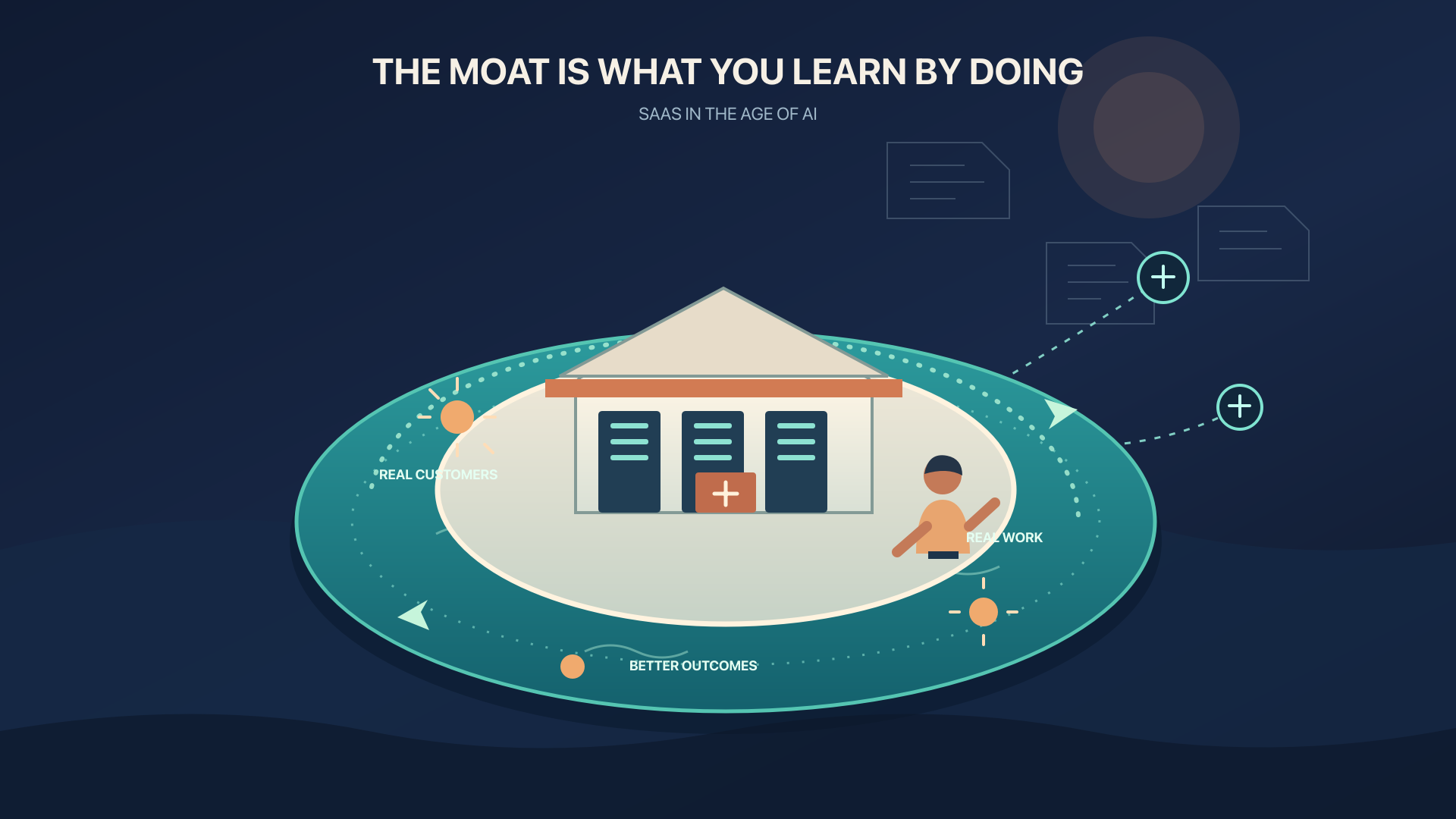
The product learns from real events on a real-world clock, and that learning can't be recreated with synthetic data. Stripe Radar improves fraud detection for every merchant using patterns seen across all of them. The authors rate this as the most durable moat.
Gut check: what do I know from real usage that a competitor couldn't simulate, scrape or buy?
8. It's hard to keep running
The product is easy to build and hard to operate. Ongoing costs only make sense when spread across many customers. ScrapingBee is the example: proxies, CAPTCHAs and anti-bot systems need constant work, month after month.
Gut check: if a customer vibe coded a perfect copy of my product, what would go wrong in six months?
Why is the learning loop the strongest moat against AI?
It is the one moat Walling and Vollset are confident will stay ahead of improving language models. An interface can be rebuilt from screenshots and a feature list can be copied. Knowledge gathered from real outcomes over time can't be scraped, simulated or bought, and it grows with every customer. You tend to get this moat almost automatically when you start selling outcomes, because each job your product completes feeds the next one.
How can a digital business go on offense with AI?
The guide describes three moves.
Move 1: Build faster
Use AI to ship more and ship sooner. Everyone is doing this, so on its own it gives no advantage. If your moats are already strong, it may be all you need.
Move 2: Welcome the agents
AI agents will increasingly use software on behalf of your customers. Offer an MCP (Model Context Protocol) server so agents can work with your product, control what they can access, and charge for that access. A simple test: ask ChatGPT, Claude or Perplexity to solve the problem your product solves without naming your brand. Does it recommend you?
Move 3: Become the worker
The authors consider this the right move for about 80 percent of founders. Most software follows a chain: you sell a tool, a business pays an employee, the employee uses the tool, and an outcome happens. Someone will eventually sell that outcome directly, and it should be you. Many recent Y Combinator launches are agentic products, but those startups lack your customers, your industry knowledge and the trust you already hold.
Selling outcomes opens labor budgets, which are far larger than software budgets, and it builds Moat 7 as a side effect. Walling and Vollset frame it as a question: if a customer pays you $75 a month today, what would you need to do for them to pay $750 a month happily?
If you price per seat, run one exercise now. Take your top 10 customers and model what happens to your revenue if each one halves the team that uses your product. If the result worries you, look at pricing on work completed (tickets resolved, calls handled, invoices processed) rather than on the people doing it.
Which playbook fits your business model?
Situation | Most exposed to | What to do next |
|---|---|---|
Self-serve, under $100/month | Attacks 1, 2 and 6 | Invest in brand and trust now. Keep the self-serve tool as the entry point and sell the "worker" as a premium, sales-assisted tier. |
Sales-led, mid-market | Attack 5 at your largest accounts | Strengthen champions and system-of-record position. Pilot one outcome-based workflow with a few trusted customers. |
Planning to sell in 6 to 18 months | Buyer scrutiny of all ten attacks | Prepare evidence for each moat, an honest exposure assessment, an agentic roadmap and pricing that survives seat cuts. |
One addition for agencies and productized-service founders, which the guide doesn't cover directly: Attack 5 works in your favor. You are the party building cheaper custom software. The defensible part is operating it over time (Moat 8) and collecting outcome data across clients (Moat 7), so price for ongoing operation instead of one-off builds.
How do you score your own AI moats?
- Score each of the 8 moats from 0 (none) to 10 (dominant). Write the evidence next to each score: named partners, contract terms, certifications, usage data. Hopes don't count.
- Pick the two or three attacks most likely to hit you in the next 12 to 24 months.
- Match your result to one of the three profiles below.
- Commit to one action this quarter and put a date on it.
Your result | What it means | Next step |
|---|---|---|
Strong moats, low exposure | You have time | Build faster and prepare your product for agents. |
One or two moats, some exposure | You have one lever | Deliberately strengthen the moat you are closest to. |
Weak moats, high exposure | You are on the clock | Take "become the worker" seriously and start now. |
Frequently asked questions
Will AI kill SaaS?
Not as a category. Walling and Vollset estimate that 10 to 20 percent of SaaS companies will go to zero, plateau or decline because of AI, and they believe most founders underestimate the risk.
What is a moat in SaaS?
A moat is anything that makes it hard for customers to leave or for competitors to take your customers. In the AI era, moats rooted in trust, regulation, network effects, operations and proprietary learning hold up better than moats rooted in code or features.
What is the strongest moat against AI?
A real-world learning loop: proprietary knowledge that accumulates as your product does actual work for actual customers, and that nobody can recreate with synthetic data.
Should I move from per-seat to outcome-based pricing?
If your customers' teams are shrinking because of AI, per-seat revenue will shrink with them even when the customers are healthy. Model the impact on your top 10 accounts first, then test pricing on work completed with a small group of trusted customers.
What does "become the worker" mean?
It means selling the result your software helps produce, instead of selling the software to the person who produces it. A support tool becomes a service that resolves tickets; a scheduling tool becomes a service that fills the calendar.
Do integrations still count as a moat?
Rarely. A documented API can be connected in a day or two with AI-assisted development. Integrations matter when they make you the system of record that other tools depend on.
Is it worth building an MCP server for my product?
If agents are likely to act for your customers, yes. An MCP server lets agents use your product under rules you control and can charge for. Without one, agents may route around you to a competitor that offers access.
Sources
- Rob Walling and Einar Vollset, "Moats in the Age of AI: Field Guide for SaaS Founders" (2026), free download with the talk recordings and slides at MicroConf: Can your SaaS survive AI?. All attacks, moats, examples and estimates in this article come from this guide unless another source is linked.
- Rob Walling, The Only SaaS Moats Left in 2026, MicroConf talk on YouTube (18 October 2026).
- Einar Vollset, SaaS Moats in the AI Era: Sell the Outcome, Not the Tool, talk at MicroConf Europe 2026, Reykjavik (YouTube).
- Rob Walling, Moats in the Age of AI: Q&A, audience Q&A after his MicroConf Europe 2026 talk (Vimeo).
- Startups For the Rest of Us, episode 855, the podcast companion to the guide.
- Startups For the Rest of Us, Episode 836: The 5 A.I. Moats Acquirers Value Most, with Einar Vollset (June 2026).
- Startups For the Rest of Us, Episode 827: The Founder's Guide to Selling Your SaaS for What It's Actually Worth (April 2026).
- Bloomberg, Traders Dump Software Stocks as AI Fears Erupt (3 February 2026).
- Ronald Weissman, Angel Capital Association, The SaaSpocalypse: Implications for Angel Investors, Part I (1 June 2026).
- Model Context Protocol documentation.
- TinySeed and Discretion Capital.